
General Information
Join us in Nepal for an expedition that goes far beyond the ordinary.
This is a 16-day custom-designed landscape photography and trekking journey through the heart of the Mount Everest region, led by Andy Mumford and Jonas Paurell. It is not designed to rush from viewpoint to viewpoint or simply tick off famous landmarks. It is built for those who want to experience the Himalaya deeply, move through it deliberately, and come away with images and memories that truly matter.
The route is a carefully crafted blend of the iconic Everest Base Camp Trek and the more remote Three Passes Trek. We have combined some of the most powerful sections of both, then refined the itinerary with additional photography days in key locations. This creates what we consider to be the ultimate photography-focused expedition in the Mount Everest region. Time is built in where it matters most, allowing light, weather, and atmosphere to shape the experience rather than a rigid schedule.
To elevate the journey even further, we use helicopter transfers instead of relying solely on unreliable airplane flights and long road logistics. This means smoother transitions, far greater flexibility, and spectacular aerial perspectives of the Himalaya. Where available, we stay in deluxe lodges, offering higher-quality comfort in this remote, high-altitude environment.
Nepal needs little introduction. Its legendary mountains, deep-rooted culture, and warm hospitality have drawn explorers, climbers, and artists for generations. For photographers, it is extraordinary. Immense snow-covered peaks, sweeping glaciers, ancient monasteries clinging to the hillsides, turquoise mountain lakes, and daily life unfolding against a dramatic mountain backdrop create endless creative possibilities.
Every element of this expedition has been shaped with intent. Locations are chosen not just for their beauty, but for their photographic depth and sense of place. The trek balances genuine adventure with space to slow down, observe, and fully engage with the landscape, the light, and the moment.
This is about shared experience. You will be traveling with like-minded photographers who value nature, storytelling, and exploration. The result is a journey that feels personal, immersive, and with just the right pace to allow your photography to flourish.

Guides

Andy Mumford
Creative Guide
Andy is a Lisbon based professional landscape and travel photographer. He is also a passionate teacher of photography and has been leading groups and one-to-one workshops for over five years, while his images and photography writing have featured in magazines and publications worldwide. As well as workshops and travelling he also produce regular videos about photography and film-making on his Youtube channel.
Andy's YouTube & Website

Jonas Paurell
Creative Guide & Expedition Leader
Jonas is the founder of Terra Photography Expeditions. He has been a photographer for well over 20 years. He is a certified International Mountain Leader (UIMLA) that has spent a lifetime exploring the world's wild areas. Jonas will be leading the expedition.
Jonas loves working with developing photographers to strengthen their technical foundation and support them to unleach their inner creativity. Jonas achieves this through engaging lectures, educative assignments and hands-on teaching in the field.
More info here.

Itinerary
Day 1 | Arrival Day Kathmandu | Sleeping Altitude 1,300m / 4,265ft
You will be met throughout the day at Kathmandu Airport (Tribhuvan International Airport) and transferred to our centrally located 4-star hotel in the heart of the city. After your arrival, the rest of the day is free to slow down, rest, and begin absorbing Nepal. The city hums outside the hotel walls. Prayer flags, traffic, incense, voices. In the evening, we gather for a welcome dinner at 7 PM to mark the beginning of the expedition and set the tone for the days ahead.
Day 2 | Kathmandu | Trek Preparation and Street Photography | Sleeping Altitude 1,300m / 4,265ft
A full day in Kathmandu. We hold a briefing, and go through gear together - making sure that everyone is prepared for what lies ahead. In between logistics, we step into the streets with cameras ready. Kathmandu is intense, layered, and endlessly visual. We photograph temples wrapped in incense smoke, chaotic markets, monks, street vendors, and quiet moments that exist just beneath the surface. This day sets the photographic mindset for the journey ahead.
Day 3 | Helicopter to Lukla – Trek to Phakding | Sleeping Altitude 2,610m / 8,562ft
A spectacular helicopter flight brings us straight into the heart of the Khumbu. Mountains rise fast as we approach Lukla. After landing, we begin trekking with an easy first day toward Phakding. The trail follows the Dudh Koshi River through forest, suspension bridges, and small mountian villages. We photograph village life, prayer wheels, mani stones, and the first real sense of scale the Himalaya offers.
Trekking: Approx. 4h
Distance: 8km / 5.0mi
Elevation: +250m / 820ft | -450m / 1,475ft
Day 4 | Phakding – Namche Bazaar | Sleeping Altitude 3,440m / 11,286ft
We follow the river north, crossing several iconic suspension bridges draped in prayer flags. At Monjo, we enter Sagarmatha National Park before beginning the long climb to Namche Bazaar. This is our first real test at altitude. The trail winds upward through forest, occasionally opening to distant mountain glimpses. Namche appears suddenly, carved into the mountainside like a natural amphitheater. Photography becomes serious here. Villages, switchbacks, peaks, and deep valleys all compete for attention.
Trekking: Approx. 7–8h
Distance: 10km / 6.2mi
Elevation: +830m / 2,723ft
Day 5 | Namche Bazaar | Acclimatization Day | Sleeping Altitude 3,440m / 11,286ft
A full acclimatization day. We hike higher during the day before returning to sleep lower, allowing the body to adapt. We explore Namche’s shops, side streets, and monasteries. Photography focuses on mountain life, textures, details, and wide mountain views. Weather permitting, this is often the first place where Mount Everest quietly reveals itself, distant but unmistakable.
Trekking: Acclimatization hikes up to 6km / 3.7mi
Elevation: +/-300m / 985ft
Day 6 | Namche Bazaar – Deboche | Sleeping Altitude 3,820m / 12,532ft
We leave Namche on the high trail with sweeping views of Everest, Lhotse, and Ama Dablam dominating the skyline. The trail undulates along the mountainside before descending to the river and climbing again through a forest to Deboche. This is a day of classic Himalayan trekking. Open views, dramatic light, and powerful mountain compositions framed by prayer flags and stupas.
Trekking: Approx. 7–8h
Distance: 12km / 7.5mi
Elevation: +600m / 1,969ft | -300m / 985ft
Day 7 | Deboche – Dingboche | Sleeping Altitude 4,410m / 14,468ft
The landscape opens as we move higher into the mountians. Trees disappear and the valley widens. Stone-walled fields protect crops from wind and cold. Dingboche sits beneath massive ridgelines with views that feel almost unreal. Afternoon light here can be extraordinary. The photography becomes cleaner, more graphic, and more abstract as the environment strips itself down to rock, ice, and sky.
Trekking: Approx. 5–6h
Distance: 10km / 6.2mi
Elevation: +600m / 1,969ft
Day 8 | Dingboche | Acclimatization Day | Sleeping Altitude 4,410m / 14,468ft
A crucial acclimatization day that allows for deeper intentional photography. Short hikes take us to surrounding ridges with expansive views across the Imja Valley toward Island Peak, Lhotse, and Ama Dablam. We work deliberately with scale, isolation, and light. The slower pace allows recovery while refining our photographic approach at altitude.
Trekking: Acclimatization hikes up to 6km / 3.7mi
Elevation: +/-300m / 985ft
Day 9 | Dingboche – Lobuche | Sleeping Altitude 4,910m / 16,108ft
We climb gradually past memorials dedicated to climbers who lost their lives on Everest. The air is thin now, and every step matters. The terrain becomes stark and glacial. Lobuche sits on a barren moraine beneath Nuptse, surrounded by ice, rock, and silence. This is high-altitude Himalayan photography at its rawest.
Trekking: Approx. 5h
Distance: 9.5km / 5.9mi
Elevation: +500m / 1,640ft
Day 10 | Lobuche – Gorak Shep – Kala Patthar – Gorak Shep
A landmark day. We trek to Gorak Shep, leave our main packs, and continue toward the summit of Kala Patthar for a spectacular sunset views of Mount Everest. The terrain is rugged and glacial, with constant views of the Khumbu Icefall below. As the sun sets, Everest and the surrounding peaks ignite in shifting light. We descend back to Gorak Shep under headlamp, tired and exhilarated.
Trekking: Approx. 7–8h
Distance: 11.5km / 7.1mi
Elevation: +610m / 2,000ft
Day 11 | Gorak Shep – Everest Base Camp – Dzongla | Sleeping Altitude 4,830m / 15,846ft
An early start for an optional visit to Everest Base Camp. Morning light across the Khumbu Icefall and the base camp offers strong photographic moments. After returning to Gorak Shep for breakfast, we descend toward Dzongla. The mood shifts. Quieter trails, wider views, and a sense of remoteness.
Trekking: Approx. 8h
Distance: 13km / 8.1mi
Elevation: +400m / 1,312ft | -700m / 2,297ft
Day 12 | Dzongla | Day Hike and Photography | Sleeping Altitude 4,830m / 15,846ft
A deliberately slow day where we can focus deeper on photography. In Jonas’ view, this is one of the stronger visual areas of the trek. Dzongla feels wild and exposed, with fewer trekkers and dramatic mountain geometry. We explore ridges, a frozen lake and glacial terrain, working with light, atmosphere, and minimalism.
Trekking: Day hikes up to 6km / 3.7mi
Elevation: +/-500m / 1,640ft
Day 13 | Dzongla – Chola Pass – Gokyo | Sleeping Altitude 4,790m / 15,715ft
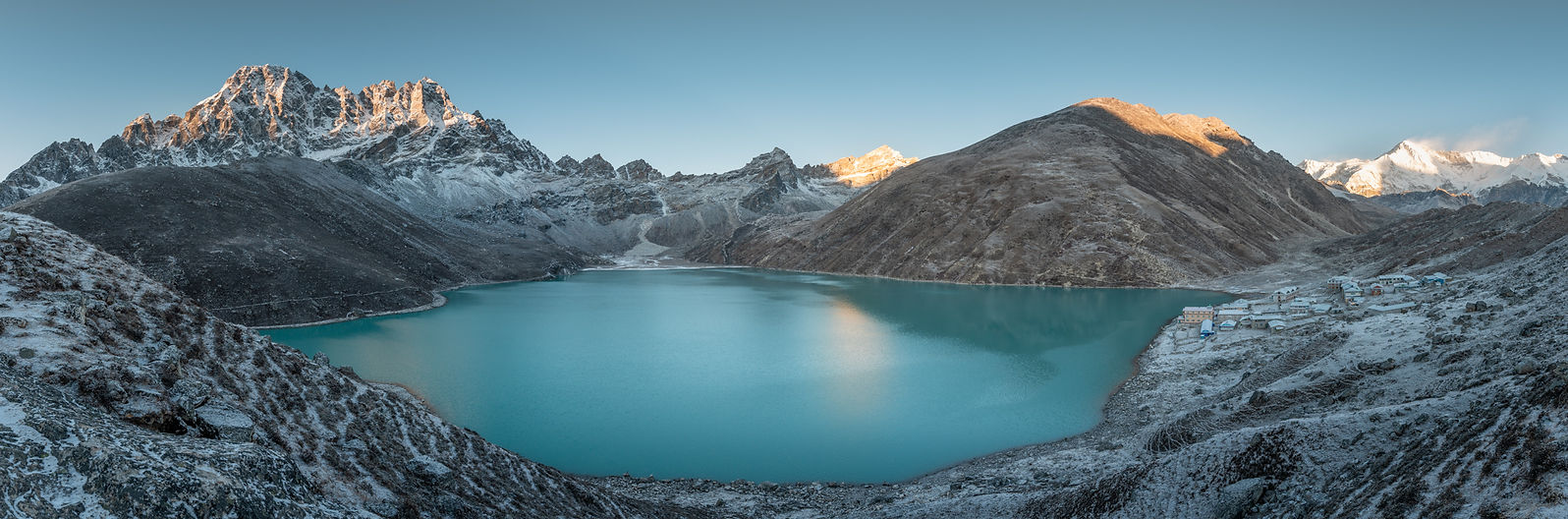
A long, demanding, and deeply rewarding day. We start before dawn, moving by headtorch toward the Chola Pass (5,420m / 17,782ft). The ascent is steep and includes glacial terrain. Crossing the pass feels like stepping into another world. On the far side, the landscape opens toward Gokyo and its surreal turquoise lakes. One of the most visually striking transitions of the entire expedition.
Trekking: Approx. 12h
Distance: 12km / 7.5mi
Elevation: +600m / 1,969ft | -650m / 2,133ft
Day 14 | Gokyo | Day Hike | Sleeping Altitude 4,790m / 15,715ft
A full day dedicated to photography in the Gokyo Valley. We explore the lakes, glaciers, and surrounding ridges. There is the option to summit Gokyo Ri for higher viewpoints overlooking the Ngozumpa Glacier and Cho Oyu. Calm conditions can produce reflections by the lakes that feel almost unreal.
Trekking: Day hikes up to 10km / 6.2mi
Elevation: +/-700m / 2,297ft
Day 15 | Helicopter Gokyo – Lukla – Kathmandu
We depart Gokyo by helicopter, flying back over glaciers, passes, and valleys to Lukla, then onward to Kathmandu. The entire route unfolds beneath us from the air. A powerful and fitting finale. Transfer to the hotel and a final celebration dinner in the evening.
Day 16 | Departure Day
The expedition officially ends today. Transfer to the airport according to your flight schedule.


Curriculum
All Terra Photography Expeditions follow a proven curriculum that aims to teach the theory behind photography in a dynamic way that directly translates into easily actionable processes in the field. As we move through nature we also go through an introduction to the skills and knowledge required to be safe in the great outdoors.
Photography Techniques Covered on the Expedition
Storytelling - Telling stories and evoking emotions within the context of landscape photography
Composition - A comprehensive introduction to the theory of composition, including the elements of art and principles of design
Process - Learning and implementing a process to achieve consistent quality in landscape photography
Focusing - A science-based method for focusing to make your images sharp
Long exposure and filters - Long exposure and the use of Neutral Density (ND) filters, especially related to moving water and clouds
Panorama photography - exposing and merging multiple images
Multiple exposures - Achieving correctly exposed images in challenging conditions using multiple exposures (exposure bracketing)
Finding locations - Using maps, weather services, and other tools to identify potential photography locations and times.
Processing Techniques (a digital session once we are back home):
Using Lightroom to apply contrast
Using local adjustments to shape and sculpt the light
Using luminosity masks in Lightroom
Different techniques for blending multiple exposures of the same image
Stitching multiple panoramas together
Sharpening images
Accommodation
For our stay in Kathmandu, we have chosen a comfortable four-star hotel right in the heart of the city.
During the expedition, accommodation will be in deluxe-level mountain lodges. The only exceptions are Lobuche, Gorakshep, and Dzongla, where no deluxe options are available. Deluxe lodges provide a higher standard of comfort, including better rooms and improved facilities.
Attached bathrooms are available in Phakding (hot shower and toilet), Namche (hot shower and toilet), Deboche (hot shower and toilet), Dingboche (toilet only), and Gokyo (hot shower and toilet). In Dingboche, Lobuche, and Dzongla, communal hot showers or hot water for washing are available at an additional cost.
Please note that all lodges along the route are extremely remote and located at high altitude. Access is only possible on foot or by helicopter. As a result, accommodation standards are more basic than those typically found in North America or Europe, even at the deluxe level.


Additional Information
Environmental and Local Ethos
This expedition is run with a strong commitment to environmental responsibility. We aim to leave as small a footprint as possible at every stage of the journey. Wherever possible, we work exclusively with local suppliers, supporting local communities and contributing directly to the regional economy.
Agenda
Weather in the high Himalaya can be stable for long periods or change rapidly within hours. While we follow a planned itinerary, the daily agenda may be adjusted as conditions require. Each day begins with a careful review of the weather forecast to ensure safe and rewarding decisions.
Helicopter Transfers to and from the Mountains
Instead of airplane flights to Lukla, this expedition uses helicopter transfers. This offers a far more luxurious, comfortable, flexible, and reliable way to access the mountains.
Helicopters are less affected by delays and cancellations than planes, allowing us to take advantage of short weather windows and reduce waiting time in Kathmandu. The experience itself is exceptional. You enjoy panoramic views of the Himalaya from the air, turning the transfer into a memorable part of the journey rather than a logistical hurdle.
Helicopter travel also allows for smoother arrivals and departures, less congestion, and a more relaxed start and finish to the expedition. It is a significant upgrade in comfort, efficiency, and overall experience.
Trekking Weather in Nepal in November
November is one of the best months for trekking in Nepal. The monsoon has fully cleared, and the winter cold has not yet settled in at lower elevations.
Days are generally dry, stable, and clear. Skies are often deep blue, with excellent visibility of the mountains. Conditions are usually ideal for both trekking and photography.
Daytime temperatures at lower elevations are pleasant, often cool in the mornings and comfortably warm by midday. As you gain altitude, temperatures drop steadily. Nights can be cold, especially above 4,000 meters, where temperatures frequently fall below freezing.
Snowfall is uncommon in early November but becomes more likely later in the month, particularly at higher passes and exposed areas. Any snow is usually light and short-lived, though occasional storms can affect plans briefly. At elevation, expect cold nights.
Weather in the Himalaya is never guaranteed. Conditions can change quickly, especially at altitude. That said, November offers a consistent combination of stable weather, clear views, and fresh temperatures for trekking in Nepal.
Trekking with Porters
The trek is supported by experienced porters. Each guest is allocated 10 kg / 22 lbs for clothing, sleeping bag, and equipment, including the weight of the duffel bag. A duffel bag will be provided upon arrival in Kathmandu.
In addition, each guest is allocated up to 1.5 kg / 3.3 lbs for a tripod to be carried by the porters. Tripods will be transported inside a duffel bag, so please ensure they are well protected without adding unnecessary bulk. Unprotected tripods may get scratched.
All remaining items, including camera gear, personal essentials, and safety items, will be carried by you in your daypack. A detailed packing list will be shared well in advance of the expedition.
Trekking at Altitude
Trekking at altitude comes with specific challenges, but it is not something to fear when approached correctly. The itinerary is designed with a gradual increase in elevation and includes multiple acclimatization days. This allows the body to adapt naturally and helps ensure an enjoyable and safe experience.
We strongly recommend consulting your doctor before the trip to confirm your fitness for high-altitude trekking and to receive personalized medical advice. If you have any questions about altitude or preparation, feel free to get in touch at any time.
How Challenging?

This is a Strenuous Mountain Workshop (Level 3) at high altitude. Previous multi-day trekking experience and a solid level of trekking fitness are required.
Daily trekking distances are not especially long (please see the itinerary for daily distances and elevation gain), as we gain altitude gradually and carefully to support acclimatization. However, high altitude adds a significant physical challenge, and the days will still be demanding.
The trails themselves are not very technical, but you should arrive well prepared for sustained trekking. We recommend doing regular hikes several times per week in the months leading up to the expedition to build endurance and confidence.
More info about effort levels here.
Price & Details
Included
Helicopter transfer: Kathmandu–Lukla
Helicopter transfer: Gokyo–Lukla
Helicopter transfer: Lukla–Kathmandu
Three licensed trekking guides (for a full group)
Eight porters for the group’s luggage (for a full group) - A maximum of 10 kg / 22 lbs per guest is allocated for clothing, sleeping bag, and equipment, including the weight of the duffel bag. A duffel bag will be provided upon arrival in Kathmandu
An additional 1.5 kg / 3.3 lbs is allocated for a tripod, carried by porters and transported in a duffel bag
Expert guidance from two professional photographers
Landscape photography in unforgettable locations
A structured photography curriculum to strengthen your landscape photography skills
Theoretical sessions
All accommodation during the expedition: 3 nights in a shared twin room at a four-star hotel in Kathmandu and 12 nights in mountain lodges during the trek (see “Accommodation” above for details)
All meals during the expedition, starting with dinner on Day 1 and ending with breakfast on Day 16
Purified drinking water during the trek
Post-processing workshop in Lightroom, including a screen recording for participants to keep
Rental of a winter sleeping bag and down jacket
Insurance for guides and porters
All required trekking permits
Excluded
Personal photography equipment
Outdoor clothing and personal gear
Snacks to eat on the go
Alcoholic beverages and soft drinks
WiFi, device charging, and extra hot shower services
International flights to and from Kathmandu, Nepal
Nepal entry visa
Gratuities for local guides and porters
Personal travel insurance (mandatory and must include medical care, accident coverage, repatriation, trip cancellation, trip interruption, helicopter rescue up to 5,999 m, and personal liability coverage)
Costs related to extra meals, accommodation, or transportation due to unforeseen circumstances, natural disasters, weather-related delays or personal reasons
Price: 10950 US$
30% deposit is due to secure your reservation, remaining 70% is due 120 days before the start of the tour. The price includes shared twin room.
Cancellation Terms:
Once the expedition status is "confirmed" the deposit is non-refundable. The balance payment is refundable up to 120 days before the start of the expedition, after that the full payment is non-refundable. We strongly recommend that all travelers purchase comprehensive travel insurance that includes coverage for cancellations due to unforeseen circumstances.
Participants: Minimum 8 - Maximum 12
Start: Kathmandu (Tribhuvan International Airport) Airport, Nov 8, 2026, Airport transfer throughout the day. Welcome dinner at 7 PM.
End: Kathmandu (Tribhuvan International Airport) Airport, Nov 23, 2026, Airport transfer throughout the day
Status: CONFIRMED!
Tour Operator: Terra Expeditions LLC
We reserve the right to change the itinerary without previous notice due to weather conditions, and unforeseeable circumstances.
This tour is governed by the Terms and Conditions